
A deep bite is one of those dental problems that can be present for years before it gets diagnosed. You might notice that your upper front teeth seem to cover your lower ones almost completely when you close your mouth, or that your lower front teeth hit the back of your upper teeth in a way that feels off. Maybe you’ve had dentists mention it in passing without explaining what it means or what to do about it.
Deep bites or excessive overbite are among the most common malocclusions treated in adult orthodontic patients. Left unaddressed, they’re not just a cosmetic issue. They’re a functional one that affects how your teeth wear over time, how your jaw moves, and in some cases, the health of your temporomandibular joint. This blog walks through what a deep bite actually is, why adults need a different treatment approach than younger patients, and how Dr. Jack Chieh-Hao Chiang at Irvine Smiles Dental approaches correction in adult cases.
What Is a Deep Bite and Why Does It Matter for Adults?
A normal bite involves the upper front teeth overlapping the lower front teeth by roughly 2 to 4 millimeters vertically. A deep bite occurs when that overlap is excessive, often 5 millimeters or more, with the upper teeth covering a significant portion of the lower ones or the lower teeth biting into the palate behind the upper front teeth.
For adults seeking orthodontic treatment in Irvine, deep bites present a set of clinical challenges. Unlike adolescent patients whose jaws are still growing, adult jaw structures are fully developed. That means treatment can’t rely on growth modification techniques. Everything must be accomplished through tooth movement, bite plane mechanics, and in some cases, interdisciplinary care. Dr. Chiang’s approach accounts for this from the start, which is why a thorough diagnosis precedes every treatment plan he puts together.
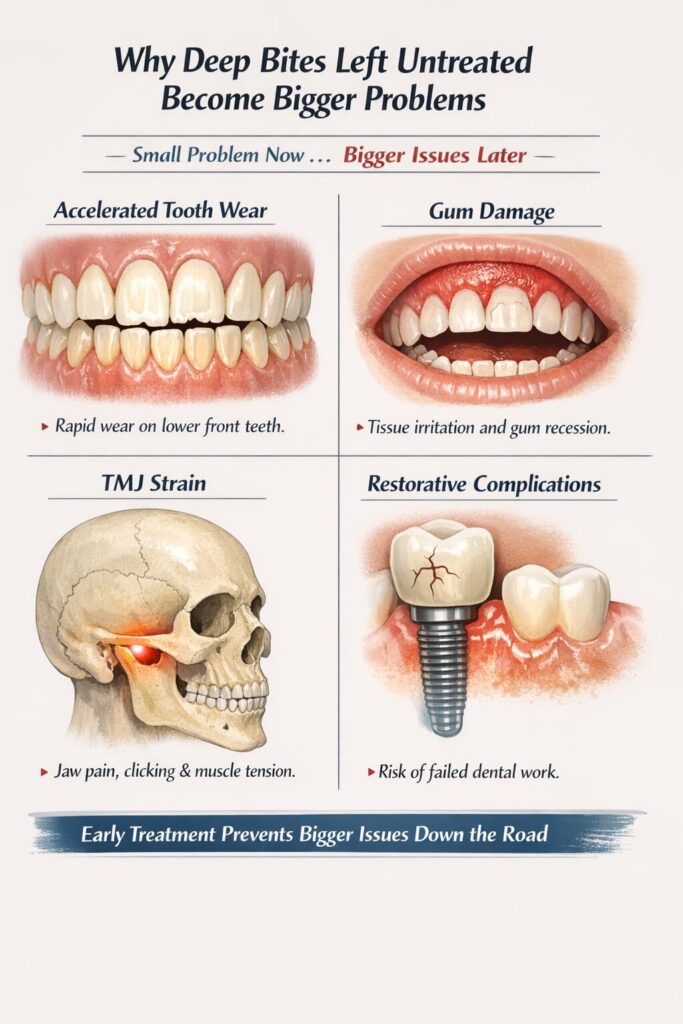
Why Deep Bites Left Untreated Become Bigger Problems
Adults sometimes carry a deep bite for decades without seeking treatment, often because it hasn’t caused obvious pain. But the structural consequences accumulate quietly over time.
- Accelerated tooth wear: The lower front teeth in a deep bite are constantly in contact with the back surfaces of the upper front teeth or the palatal tissue. Over the years, this abrades enamel at a rate faster than an aligned bite would.
- Gum tissue damage: When the lower teeth bite into soft palatal tissue rather than contacting the upper teeth correctly, it can cause localized gum recession and tissue trauma that worsens gradually.
- TMJ strain: A deep bite changes the closing pattern of the jaw. Over time, this can contribute to temporomandibular joint dysfunction, jaw clicking, or chronic muscle tension in the face and neck.
- Complications for restorative work: If you ever need crowns, veneers, or implants, a deep bite must often be addressed first. Placing restorations into a bite that puts excessive force on certain teeth is a reliable way to have those restorations fail early.
None of these happens overnight, which is why deep bites stay under the radar for so long. But the trajectory is clear, and treating them earlier in adulthood is consistently better than waiting until restorative needs force the issue.
Dr. Chiang’s Approach to Treating Deep Bites in Adults
Dr. Jack Chieh-Hao Chiang takes a methodical, staged approach to deep bite correction, and that approach shifts depending on the severity of the overbite, the condition of existing teeth, and what the patient needs functionally and aesthetically.
Comprehensive Diagnosis First
Before any brackets are placed or aligners ordered, Dr. Chiang conducts a full occlusal analysis. This includes digital X-rays, intraoral scans, and a detailed evaluation of how the upper and lower arches relate to each other in three dimensions. Understanding exactly where the bite discrepancy originates, whether it’s driven by dental position, skeletal structure, or a combination, determines which mechanics will actually correct it.
Bite Planes and Intrusion Mechanics
One of the most effective tools for correcting a deep bite in adults is bite turbos or bite planes placed on the back teeth, which prevent the deep bite from closing fully and allow the front teeth to be repositioned without constant interference. This gives Dr. Chiang the freedom to move teeth more efficiently. In conjunction, intrusion mechanics are used to move the upper or lower front teeth vertically into the bone, reducing the effective depth of the overbite. This is delicate work because it requires precise force vectors over a controlled timeline.
Braces vs. Clear Aligners for Deep Bites
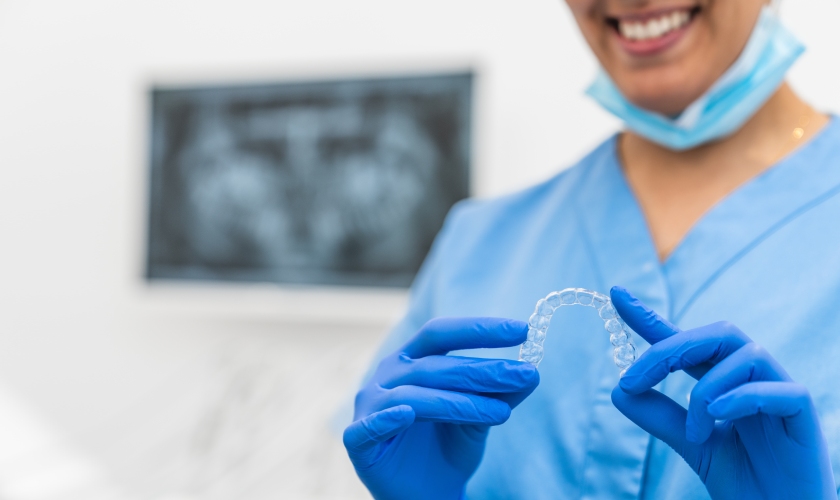
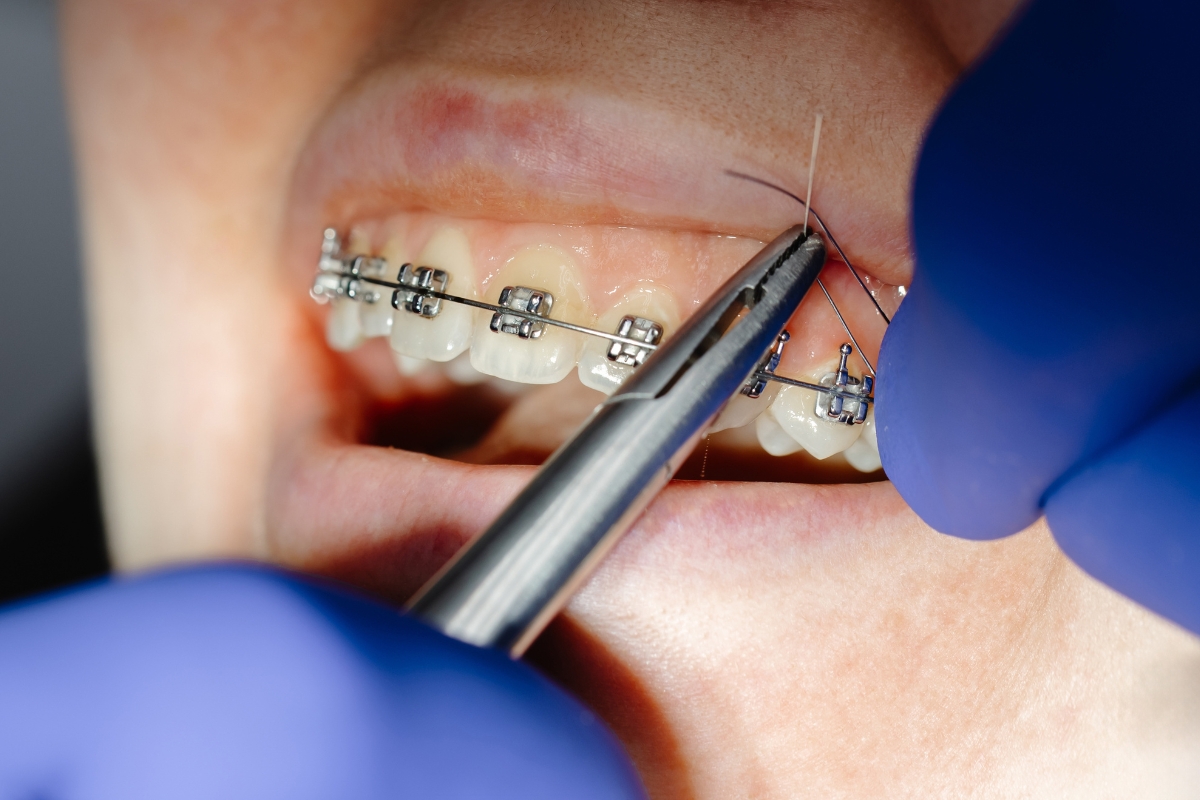
Both traditional braces and clear aligner systems like Invisalign can treat deep bites, but their suitability depends on case complexity. Moderate to severe deep bites in adults often respond better to braces in Irvine, where brackets and wires allow for more precise control of vertical tooth movement. Clear aligners have improved significantly for deep bite correction and work well for milder cases or patients who are strong candidates based on their specific tooth position. Dr. Chiang discusses both options with patients and recommends based on clinical need, not preference or convenience.
Retention and Long-Term Stability
Deep bites have a tendency to relapse if retention isn’t handled carefully after active treatment ends. Teeth have a memory, particularly in adults, where the surrounding bone has been stable for decades. Dr. Chiang builds a retention strategy into every deep bite case, typically involving a combination of fixed lingual retainers behind the front teeth and removable retainers to maintain vertical corrections. Patients are given clear guidance on retention schedules and what to watch for over time.
A deep bite that’s been with you for years isn’t something you simply have to live with. Treatment options for adults have advanced considerably, and Dr. Chiang brings both the clinical precision and the patient-centered communication that complex cases require.
Book a consultation at Irvine Smiles Dental today. Whether you’re exploring orthodontic treatment in Irvine for the first time or following up on something a previous dentist flagged, our team will give you a complete, honest assessment and a clear treatment option forward.
People Also Ask
How long does deep bite correction take in adults?
Treatment timelines for adult deep bite correction typically range from 18 to 36 months, depending on severity, the mechanics used, and how the patient’s teeth respond. Cases involving significant tooth movement or the need for preparatory dental work before orthodontics begins tend to run longer. Dr. Chiang gives patients a realistic timeline estimate after completing the diagnostic records, not before.
Can a deep bite cause headaches or jaw pain?
Yes. An excessive overbite changes how the jaw closes and can put uneven strain on the muscles and joints that control jaw movement. This sometimes presents as chronic headaches, facial muscle tension, or discomfort in the temporomandibular joint, particularly after long periods of chewing or talking. Correcting the bite often reduces these symptoms, though it’s important to evaluate whether TMJ dysfunction is also present before beginning orthodontic treatment.
Is surgery ever needed to correct a deep bite in adults?
Orthognathic surgery is considered in cases where a deep bite has a significant skeletal component, meaning the jaw position itself, rather than just tooth position, is contributing to the problem. These cases are less common than purely dental deep bites, but do exist. When surgery is indicated, Dr. Chiang works in coordination with an oral surgeon, and orthodontic treatment is typically completed in phases before and after the surgical procedure.
Do deep bites affect speech?
In some cases, yes. A pronounced deep bite can affect how the tongue contacts the upper palate during certain sounds, particularly sibilants like “s” and “z.” Patients occasionally notice a slight lisp or feel that certain sounds require more effort to produce clearly. These speech patterns can improve after deep bite correction as the tongue gains proper clearance and the bite relationship normalizes.